
"coffee cultivation altitude"
8000 article(s) found

A brief introduction to the cultivation of boutique coffee beans with long-lasting aroma, geographical location, climate and altitude
Papua New Guinea has a detached and primitive natural environment and its land is vast and fertile. Its unique volcanic rock soil and abundant rainfall create excellent natural conditions for the growth of coffee. The top coffee beans in Papua New Guinea are as beautiful and precious as the country's national bird of paradise. Large manor / farm (plantation), usually with its own washing plant

The smooth taste of Kaiser Louis Manor Fine Coffee Bean cultivation, geographical location, climate, altitude is simple.
Elida Manor has a total area of 65 hectares, more than half of which are located within Baru Volcano National Park, 30 hectares of which are planted with coffee trees, and the remaining 35 hectares are primeval forest Elida Manor located in the Poquet producing area of Chiriki Province, a province on the western border of Panama. The most famous landmark and tourist attraction of the province is the Baru Volcano-Baru, which is 3300 meters above sea level.

A brief introduction to the cultivation of exquisite coffee beans in the noble Crystal Mountain of Cuba, geographical location, climate and altitude
Crystal Mountain Coffee beans are typical island beans with a clean and delicate taste, slightly sour taste, not strong but long-lasting, with sweet fruit aromas. The coffee made by it was owned by Jane in 1748, and coffee was introduced to Cuba from Domiga, and Cuba has been growing coffee ever since. With fertile land, humid climate and abundant Rain Water, Cuba can be called a natural treasure land for coffee cultivation. Suitable self

Scientific Research and cultivation of Coffee in Costa Rica
Coffee is an important economic source of Costa Rica. It was introduced in 1808 and has been cultivated for 200 years. Costa Rica has 1x3 population invested in related industries. Colombians say that coffee has changed the country and enjoyed a rich environment, and coffee has indeed made an outstanding contribution. Although Costa Rica ranks third from the bottom in terms of land area in Central America, its economic environment is better than that of Central America.
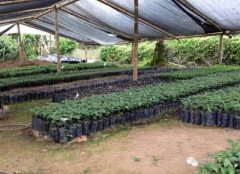
A brief introduction to the cultivation of high-quality Angolan boutique coffee beans, geographical location, climate and altitude
The Secretary-General of the African Coffee Organization (Coffee Organization), Joseph Farrayasarko, said on the 10th that Angola is expected to regain its status as a major coffee producer in the world due to the launch of a nationwide coffee planting campaign. In analyzing the global financial crisis and the situation of the international coffee market, Sako said that there are still gaps in the international coffee market. Angolan coffee should not only improve its output, but also its quality.

A brief introduction to the cultivation of fine coffee beans in Berman Manor with charming acidity, geographical location, climate and altitude
Kenya Kenya Coffee Kenya Kenya is the origin of Arabica coffee trees in Kenya, but it was not until the beginning of the 20th century that coffee cultivation began. In the 19th century, missionaries introduced Arabica trees from the leaves, but did not plant them in large quantities. It was not until 1893 that coffee was cultivated on a large scale after the introduction of Brazil's ancient bourbon seeds, that is to say, the current Keny.

A brief introduction to the cultivation of boutique coffee beans on Mount Everest in El Salvador, geographical location, climate and altitude
The current situation of coffee production is a natural and man-made disaster, which is a perfect description of the challenges facing the coffee industry in El Salvador. Despite getting rid of the haze of war, El Salvador's coffee production still faces challenges from time to time, including: 1998, hurricanes; 2001, earthquakes; 2002, volcanic eruptions; 2012, leaf rust
Flavor and taste characteristics of Costa Rican coffee beans introduction to the history of planting varieties in Costa Rican coffee producing areas
The most important feature of Costa Rican coffee is its unrestrained aroma, fresh and dry acidity, and a balanced and pleasant classic flavor. Costa Rica has the acidity of Central American coffee beans, coupled with years of variety improvement and honey treatment in Costa Rica, which gives Costa Rican coffee attractive.

Light sweet Cuban crystal mountain boutique coffee beans cultivation geographical location climate altitude brief introduction
Cubita has been praised and affirmed by diners from all over the world, known as the unique Caribbean coffee, the special coffee beans in the island coffee beans Yunyun Shuijing Mountain Coffee comes from the Cuban Crystal Mountain, so it is called Cuban Crystal Mountain Coffee. Crystal Mountain Coffee is synonymous with top Cuban coffee, because this area not only grows coffee, but also produces quartz, crystal and other precious minerals. Crystal

The cultivation of boutique coffee beans on Mount Qomolangma in El Salvador with excellent balance, geographical location, climate, simple altitude.
Despite the challenges, El Salvador maintained a high level of coffee production, according to ICO International Coffee Organization, from 2008 to 2012, total coffee production in El Salvador remained at the Top15 level among ICO member countries. In 2013, affected by the leaf rust disaster, 70% of domestic farms were infected, and the output dropped sharply by about 40%, falling to 16. Salvadoran coffee and Mexico

The natural conditions of coffee cultivation Arabica requires high planting conditions in order to produce high quality.
Professional coffee knowledge exchange more coffee bean information please pay attention to the coffee workshop (Wechat official account cafe_style) front street-Arabica coffee planting conditions introduction the higher the elevation of coffee trees, coffee quality will be relatively good, such as Arabica beans are in the altitude of 1000-2000 meters above sea level, Robbosa beans are generally located in the plains below 800m

Scientific Research and cultivation of Coffee beans in Costa Rica
The research center, located about 30 kilometers northeast of San Jose, the capital of Costa Rica, belongs to the Costa Rican Coffee Association and is the research institution for planting, breeding and quality inspection of Brazilian coffee fruits in Costa rica. in addition, it also has 10 hectares of experimental plots, planting a number of excellent varieties. Coffee is the main agricultural product in Costa Rica, with an annual output of more than 2 million bags

Introduction of three varieties of Coffee the difference between the characteristics of Arabica Coffee Bean Robusta Liberica Coffee
There are three kinds of coffee used for commercial cultivation in the world, namely, small-grain Arabica coffee, medium-grain Robsta coffee and large-grain Liberika coffee. So what are the characteristics of each of the three kinds of coffee? The origin of Arabica coffee originated from the Ethiopian plateau. Because of its excellent flavor and quality, Arabica coffee has been widely cultivated, and its coffee output accounts for all of it.

A brief introduction to the cultivation of Panamanian Cupid coffee with bright taste and fine taste
This estate has led to the growth of Geisha in many coffee plantations not only in Panama but also throughout Central America. For many coffee farmers, this variety means a high price, and to a large extent, this perception is correct. Because as a manor growing Geisha, the price of its coffee is always higher than that of other estates. Traceable origin Panamanian coffee set

Yunnan small Coffee with long aftertaste treatment method of Grinding degree and Baking degree of Fine Coffee beans in Huaguoshan
Cardamo Catimor is an improved variety of Tiebika seed, with 25% Robusta gene Yunnan small-grain coffee with good quality. Take Lujiangba small-grain coffee as an example: the percentage contents of the main components are as follows: crude fat 17.1, reducing sugar 0.93,starch 3.07,nitrogen 2.27,crude protein 1.419, ash 3.70,19.33 crude fiber, 2.14,9.20 sucrose and 6.87 moisture. Cloud

Fragrant Goddess Manor Fine Coffee Bean cultivation, Geographic location, Climate and altitude
Costa Rican coffee has full particles, ideal acidity and unique strong flavor. High-quality Costa Rican coffee is called extra hard beans, and this kind of coffee can grow at an altitude of more than 1500 meters. Altitude has always been a problem for coffee growers. The higher the altitude, the better the coffee beans, not only because higher altitude can increase the acidity of coffee beans and thus increase the flavor, but also by

A brief introduction to the cultivation of Coffee in Diamond Hill Manor in Costa Rica, Climate and altitude
It keeps the coffee clean by washing, and because it is dried in the sun together with the pulp mucosa, it greatly increases the sweetness and caramel flavor of the coffee (the sugar content of the pulp mucosa is extremely high). Honey treatment first appeared in Costa Rica in Central America, a total of eight Costa Rica producing areas, of which it is recognized that the three best producing areas, Tarazu, the Central Valley, the Western Valley, Lajas

A brief introduction to the cultivation of boutique coffee beans in the Goddess Manor with good sweetness, geographical location, climate and altitude
This coffee producer, coffee of all grades and types accounts for 1/3 of the global consumption and occupies a place in the global coffee market, although the natural disasters faced by Costa Rica are several times higher than those in other regions. but its plantable area is enough to make up for the obvious acidity of Costa Rican coffee, which is strong but not exciting and divergent.

A brief introduction to the cultivation of Guatemalan boutique coffee beans with balanced acidity, geographical location, climate and altitude
The coffee industry, run by the Mayans, once boomed Guatemala's economy and dominated the national economy. Unfortunately, the political situation in Guatemala is not good for these coffee growers. High output is usually a sign of a country's overall economic prosperity. However, coffee production in Guatemala has declined relatively, at only 700 kilograms per hectare.

A brief introduction to the cultivation of boutique coffee beans on Mount Everest in El Salvador, geographical location, climate and altitude
A brief History of Coffee production in 1742, coffee was introduced to El Salvador from the Caribbean (1740). In the mid-19th century, El Salvador's original export pillar Indigo (one of the dyes) received a gradual decline in the development of synthetic dyes in Europe, and coffee gradually became the main export product under the guidance of the government. In 1856, the first 693 bags of coffee beans were shipped to Europe. all long